Sunday, April 29, 2018

What do physicists whine about most?

I wouldn’t say whine. I have never seen a physicist whine. We are too high on coffee to do that, we just tear things apart, ripping the fabric of space-time. But I can tell what a physicist may feel uncomfortable with, and will use myself as an example for a couple of those.
One thing I believe we’re not comfortable with is when people assume we are geniuses just because we are doing physics. Don’t get me wrong, I am talking about the kids (and by kids, I mean mentally immature, not an actual minor. We have to specify everything, or else the internet crucifies you, like "someone" was allegedly... I am digressing) on the internet who say things like “Hey look, I have an IQ in the 99th percentile, look at me”, and also, physics does demand a lot of work to be understood, but I don’t like when I see people using things like “I read Quantum Mechanics books because I am very smart”. Like, many people think Einstein achieved what he did just because of his intellect, and I think that is an offense to Einstein, by disregarding the efforts he did. Sure, having an IQ of 200 is great, but if you don’t make at least the effort to learn something you will definitely not achieve anything. That being said, there are various examples of physicists you could describe as being prodigies, like Von Neumann, Dyson or Witten. But most physicist that go to work on the field, do it because they love what they are working on, and not because they feel like “With my intellect, this is the least I could do to you, mere lesser minds (Who speaks like this?)”. Again, I am not generalizing. Maybe there are geniuses who are also selfish pricks, and yes that sounds contradictory, but we are humans, contradiction, dichotomy materialized in flesh. Just so we can be clear, I looked up for dichotomy in the dictionary before using it. In the same, even best physicists today will still look for work done by those before him. Not only because we want to learn what they discovered, but for more trivial reasons, like plagiarism. Who cares if you found a new cure for cancer? If you don't quote those who did a prior work on that, who may have had come close to reaching your conclusion, a lawyer is coming up in your ass with a lawsuit. And you will lose credibility, and the scientific community will pretty much ignore you, and we don't want our brightest minds to go to waste, just because of some silly pride. So yeah, that is one frustration for me. Sure, we can say, that it may also be because I am stupid, and I take it. Yeah, I am stupid. Which is why I try to find ways to not be stupid anymore.
And also, really important, all this new age bullsh*t about quantum this, quantum that, magnetic something something, usually related to some biological or medical principle, like quantum mind (Now there is quantum biology, and that is a legit science)… The reason this ticks me of is because it affects my field. Whenever someone hears medical physics, or biophysics they start saying, oh yeah I heard about your field. I am like, “Really? I thought mine was a darkhorse in the different subfields of physics”, and then I just hear a “I’ve reading specially a lot on the quantum nature of consciousness” (Now again, we can use the mathematical methods in quantum mechanics and apply it to neurophysics, but in no way we assume brain activity to have a quantum feature) or “Do you work on magnetic therapy?” (We do use magnetic fields in medical and biological physics, but as far as I am aware, only in imaging and spectroscopy)*. I guess it is the same with astronomers and astrophysicists when they get asked “I was born in April, do you know the effects Jupiter has on me?” (While this is a hypothetical, I do know a friend of mine who went through this). Sure, these people are not at fault, they were just misinformed, my real frustration is with those gurus that spread these false statements as factual. We physicists do enjoy a bit of pondering and philosophy, but when you take that thought experiment and turn it into something “factual”, not only you have gone out of physics, you left the realm of science altogether.

I mean, today I was talking about it with this friend of mine. She is more tolerant to them, and even sometimes we joke around with astrology, but that is because most of us have already accepted astrology as a pseudo-science. And those who go there, don't think they will actually meet with a scientist. However, those who go to homeopaths, actually believe they are meeting with a respectable doctor. And that is dangerous. 
Sorry for my long rant, but these are things that I think could possibly make us whine a lot. And to all other physicists, if you think I exagerated on some parts or if you think I left something out, please tell me.

*An update to that, actually we can use magnetic fields for therapy, but definitely not in the way they are talking about it.

Sunday, April 15, 2018

What are the different types of physicists?

So in the last two posts I was talking about how experimental and theoretical physicists may complement each other, and how the future of physics and science as a whole may be doomed if we leave everything at the ends of lobbyists and legislators. But then it occured to me that we don't really know how many kinds of physicists are there. This is an oversimplified version of many colleges, and universities curricula in way to properly say what the consensus for different types of physicists.
Now there are many ways to answer that. First, we need to go with conventions We start by answering at a more fundamental level, you have two types of physicists, fundamental physicists and applied physicists. What is the main difference between the two? Arguably the same as a theoretical mathematician and applied mathematician. Which means, that while both applied and theoretical physicists can work on the same subject, an applied physicist would work on a subject in order to find a pratical use out of it. Now while this seems similar to engineering, it is not exactly the same thing, since an applied physicist will most likely be doing research on the physics of some thing, and later may find some use for it. A good example would be physicists Lauterbur and Mansfield, which applied the physics of nuclear spin and magnetic resonance to medical imaging, completely revolutionizing the field. On the same note, a fundamental physicist would also be researching the physics behind some particular phenomena, while not being particularly interested in the use it may have, they would doing research just for the sake of knowledge and physics. Using spin again, a good example would be physicists Bloch and Purcell, which found a mathematical model that could describe the behavior of nuclei under magnetic fields, and the phenomena of magnetic resonance that would occur.
When 80 years of work and anything between 7 to 9 Nobel Prizes, from Physics to Physiology & Medicine, led to this wonder of a machine.
Besides of fundamental physics and applied physics, you may divide physics in two other (maybe three) types of physicists. You have the theoretical physicist, the experimental physicist, and while many believe a computational physicist to be a theoretical physicist, some argue that it may be a type of its own. A theoretical physicist would as the name implies either develop mathematical models to describe phenomena that were observed experimentally, or to predict outcomes that will be observed experimentally (nowadays it is mostly the latter, technology is lagging behind), while the experimentalist usually would try to verify results predicted by the theoretician, or just would do a random experiment and see what happens. (Before, most physicists were both experimentalists and theoreticians, but today most physicists like to dedicate to one thing or the other) Also, experimentalists would also work on ways to make the observations more reliable or statistically significant, or to be able to make experiments in different, or more extreme conditions. Sometimes, developments on experimental physics will be applied by applied physicists in other fields (like how they are now using the detector tech developed to detect the Higgs boson in other fields like nuclear medicine or in telecommunications). A computational physicist would pretty much run simulations of the theories in computers to try and see what the results could be. Now this is important, because nowadays physical experiments are expensive, so instead of doing experiments everytime we come up with a new hypothesis, we run simulations on computers. If the simulations are good, or what we expected, cool, if not, we have to change something. While this may seem something that a theoretician would do, and many do, a computational physicist would be working on various other things. They could, for instance, work on computational methods that allow for better, faster simulations, and those things are hard to do. Believe me. And that is why many are now believing that computational physics is a type of physics distinct of pure theoretical physics. (And also applied physicists may also be computational or experimental physicists just saying).
This is what a theoretical physicist would be doing. Although nowadays they are a bit more tech savvy, they would probably be writing on glass or something. I don’t think there is any practical use to that, but there a whole lot of things written in glass on some places.
And the exciting life of a experimental physicist. Imagine if one of those cables are not conducting, the struggle to find the one.
And the day-to-day life of a computational physicist, in that moment the code finally compiles, after 3 full bottles of coffee and 6 hours.
Now the part everyone cares about, the divisions of fields in physics. Truth be told, it is very hard for a single person to be working on various fields at the same time nowadays, so it became important to make distinction between those fields.
First, we have Nuclear and Particle Physics, which is like the poster child of modern physics (I mean, literally every person thinks that a modern physicist is either a particle physicist or astrophysicist). And they usually worry with the fundamental forces and constituents of nature. It was started with the discovery of the nucleus by Rutherford or with the discovery of radioactivity by Becquerel, about a 100 years, and right now, it is the field where such hot topics like the Higgs Boson, Supersymmetry, quantum gravity, GUT and string theory are extensively researched. On the applied field, there is a surprisingly high number of applications of Nuclear Physics, like the entire field of Medical Imaging and Radiotherapy, being pretty much Applied Nuclear Physics (with knowledge of physiology and anatomy), and let’s not forget Nuclear Energy, and Nuclear Bombs. As for particle physics, I don’t think we will have an application for it so soon.
Look at how beautiful this image is. I don’t know what they collided, but I can just imagine the excitement generated by the results. “Maybe it was just a flutuation” is what they will likely say, since NPPhysicists are usually those whose scientific experiments need to be the most statistically precise. And by precise, I mean 1 chance per billion of being wrong, p = 0.0000001. How about that? And you with your pitiful p = 5 or 1.
We also have Condensed Matter Physics, that studies condensed matter (like liquids and solids, and everything in between) and their physical properties. They study things like phase transitions and distributions of energy and states, something statistical physics, I guess. And they apply various fields of both classical and modern physics, like quantum mechanics. This field overlaps with others like Chemistry, and Biophysics (an applied physics) and has some cool things to be studied like superfluidity and supercondutivity, and topological phase transitions. Usually the field is subdivided in Solid State Matter Physicsand Soft Matter Physics. Now, while Physics doesn’t have a industry of its own (like the Chemical Industry) you can say that arguably, the most important field of Modern Physics to industry is CMPhysics, specially SSMatter Physics, because all of modern electronics is based on research in CMP. So, you can imagine that the applications usually involve nanotechnology, semicondutors, and oddly enough, or maybe not, even MRI (which kind of makes sense, thanks to superconductivity)
A Bose-Einstein Condensate. This a phase of matter where the state distribution of particle follow the Bose-Einstein statistics. Particles who follow this statistics are called Bosons, and they all have integer spin.
Am I forgetting something…
Right, we still have atomic and molecular physics and astrophysics and classical physics, that while not being a research for physicists anymore, are still very researched in engineering and mathematics, because of the so-called chaos theory. Right now, I will stop right here, but I will complete this latter. I am feeling lazy right now, sorry AMPhysicists and Astrophysicists, but don’t worry, your turn will come.
EDIT: So now, I am supposed to finish this, huh? Oh boy!
So, we also have AMO Physicists, which stand for Atomic, Molecular and Optical Physics. And their name is kind of self-explanatory, but I will make an effort. They are usually worried with interaction between matter and light, or just matter-matter, or even light-light (I don’t know, the possibilities are enormous). And they are also divided in (you guessed it) Atomic physics, Molecular physics and Optical Physics. Atomic physics is concerned with studying the physics of a system composed of electrons and a nucleus. While it may seem they do the same thing as nuclear physicists, that’s hardly the case. They usually are concerned with the system of electrons and the nucleus and their interactions, while nuclear physicists usually deal with atomic nuclei and their properties, disregarding their interaction with electron for most fundamental models. As for molecular physics, it is less about the inner workings of atoms, and more with how molecules interact with each other. As you can imagine by that, there are fields like physical or theoretical chemistry which are concerned with pretty much the same thing, so they hang out together a lot. Optical Physics is primarily studying light. The nature of light, the behaviour of light, the interactions of light with itself, interactions of light with matter, it’s all tied to light. Now when I say light, I mean electromagnetic radiation, they study all the electromagnetic spectrum, not just visible light.
Lasers… Enough said. I am still for those light sabers, though.
Now let’s go to the sexiest physicists out there. Astrophysicists! If I didn’t put them down here, probably the guys would just read this part and leave without caring for the rest. Now astrophysicists are just worried about one thing: The nature of heavenly bodies and the physics (and chemistry) behind all astronomical events. That is their "thing". Astrophysicists are usually seen (or maybe I am the one who seems them like that) as one of the two extremes in physics, dealing with the physics of the very large, while particle physics deal with the physics of the very small. And considering the scale and variety of things to work on, obviously it also has subdivisions. I mean, you have Planetary Physics, with Geophysics specifically focused on Earth, that studies planets and their physical properties, including extrasolar planets. You have Solar Physics that studies the heavenly bodies in the Solar System and their interaction, studying things like the motion of bodies inside of the solar system, which is not easy because you have a multiple body system where all those bodies interact with each other and generate their own gravitational field. You have Stellar Physics that study the physics of stars, like star formation, stellar activity and stellar death, the Heliophysics specifically studying the Sun. They also study things like Black holes and Neutron Stars. (I don’t know if you realised but the trend is to keep getting bigger in scale) You have galactic physics that studies the physics of well galaxies, how stars interact with each other inside a galaxy, how a galaxy forms, what is the physics behind galaxy conformation, and other questions. You even have extragalactic physics, that study interactions between galaxies, the distribution of galaxies in a group, and extragalactic bodies, like quasars or pulsars. And finally the crown jewel, Cosmology that studies the fundamental and cooler stuff in astrophysicist (from a pop science POV). They study the entire universe, its evolution, its beginnings, and its possible end. Also they study the nature of spacetime, like the existence or not of wormholes, multiple universes, Dark Matter, Dark Energy and Gravitational Waves (There are definitely some Metal bands with at least one of these names). As for applications, there are way too many, and this article is getting way too long.
The main thing you need to know is that physics is very diverse, and you could do things that would change the world, but most important of all, no matter how hard you may think of it, physics is something you should do only if you like it enough. If you are willing to work on the same problem, sometimes for decades, just to get that one confirmation of a fundamental truth. You may not win a Nobel, but damn, you would feel joy in working on this amazing field. Scientia Prima as some would say.

Also, just leave a comment below or anything, so I can have a feedback from you guys, I don't want to talk to a wall.

Sunday, April 8, 2018

What is wrong with modern physics?

I will rant a bit about my personal frustrations and hopes for the future of modern physics. Now, sure I ain't shit, but to be honest neither are most future physicists. As of right now, we are only prospect physicists, many of us will work on the tech industry, many in the financial market, and many will give up to insanity and start talking nonsense like "quantum mysticism". But if we want to start, if you are talking about concepts in modern physics, well, is the fact that it is incomplete. Why that is? Well, for many reasons. For one, right now, we are trying to understand physics at the most extreme environments in the universe, many of which we will probably never be able to reach. Before an hypothesis has been well established you already have a new, better hypothesis (which is great, so that is actually what is right with modern physics).
But the main problem is the fact that our technology can’t keep up. Many of the theories in Modern Physics can only be confirmed if they are verified experimentally. Before when Physics was mostly done by people who had their own wealth, experimentalists would take a year or two to dismiss or prove some hypothesis, but nowadays, while it is easier to become a physicist than ever before, it is also harder to do physics, so hard that only budgets of countries could afford to do so.
And then we reach another problem, countries may not be that interested in investing in physical research, because while research in chemistry and biology have a clear practical use, usually it takes 60 to 70 years for one to find any sort of use from physical principles. I mean, many of the technologies we take for granted today are based on physics from 60 years ago, to say the least. And lawmakers aren’t interested in investing in things at such long scales (F*ck why do you think many of them don’t believe in Climate Change?). I mean, in the 30’s and 40’s they at least had the motivation of nukes.
But still we are doing some advancements every year, and I understand your feelings, if you compare to last century and how fast physics seemed to advance, in a couple of decades, entire paradigm shifts occurring, it was a joy to be alive back then. But it is not all that bad today. As I said, we have more people working on physics now than ever before, even though many people are dropping out. So while we may not have a generation of physics wonders, we do have an entire army of physicists working not only in fundamental research, but also on applied physics, so we can directly improve your life, and so those lawmakers can see that “Hey, maybe we should invest a bit more on this, and less on our behemoth of an army”.
I let my anti-war sentiments slip there a bit, but I hope I answered your question.

Tuesday, April 3, 2018

Who is smarter between theoretical physicists and experimental physicists? - A personal take

So this was a question asked by someone on Quora, and I found it interesting enough to answer not because I am a theoretical or experimental physicist and I am butt-hurt or similar. But because  many outside of the scientific community seems to think there is some sort of rivalry between physicists of different approaches or fields. So this is my take on that. In the time, I will try to look for someone who has actually worked for more than a decade as a physicist, they would have a lot more to say than me. But to start...
I guess it really depends on what you mean by smart.
For instance, the usual definition of smart, is someone that is quick-witted, someone is quick to take decisions, but also intelligent, so a smart person is someone that has quick-witted intelligent. Just because you are intelligent, wouldn’t mean you are quick-witted and vice-versa. Now it is true, that in American english, smart is synonymous with intelligent, so I guess what you mean is who is more intelligent. And going by that, an intelligent person is someone who is able to acquire AND apply knowledge and skills. 

And we can assume both theoretical and experimental physicists would need to be able to acquire knowledge and apply such knowledges, for the sake of obtaining new knowledge. Now as for who is more intelligent, that depends on what you need, what knowledge or skill you are considering. Pure logical or mathematical reasoning may seem like the bulk of a theoretical physicist’s work, but they also need to be able to interpret new results obtained by an experimentalist, in order to either reject or change their previous theory. On that same note, an experimentalist would need to know how to obtain and analyze the results of an experiment, but also would to know enough about the theory to either dismiss the results as nonsense or an artifact, or to actually challenge the theory itself (or hypothesis, if the theory has yet to be established as such). And actually, many physicists end up working a certain time of their careers in both sides, so trying to say one is smarter than the other may be tough, with this mass flip-flopping around the pond.
But anyway, here are some famous physicists from both sides (Not including Einstein, because well, you know him)
Experimentalists:
  • Michael Faraday (which is actually interesting, albeit not having formal education in physics, and being kinda sloppy in mathematics, actually was such a brilliant experimentalist that he was one of the forefathers of the classic theory of electromagnetism)
  • Wilhem Roentgen - The first Nobel Prize in Physics, for the discovery of X-rays
  • Ernest Rutherford, known as the father of nuclear physics, and the greatest experimentalist of his time, since Faraday. Also he discovered the nucleus, for which he was awarded a Nobel Prize in Chemistry. Also, he has an element with his name (Cool!)
  • Enrico Fermi, creator of the world first nuclear reactor, and called by some as the “architect of the nuclear age” (or the atomic bomb). He is actually one of those physicists who are great both experimentally and theoretically, making advancements in quantum theory, nuclear and particle physics and statistical mechanics. Also a Nobel Prize winner.
  • John Bardeen, also a physicist and electrical engineer, who has part of the trio who made the first transistor (which revolutionized the world, I mean, the entire modern computation can stem its hardware to that pivotal moment) with Shockley and Brattain, and also the guy who made the first formal theory of superconductivity (also known as BCS theory, for Bardeen, Cooper and Schrieffer). He is actually the ONLY physicist to have won two Nobel Prizes in Physics. (Marie Curie won one in Chemistry. Of course, she was a great experimentalist as well)
Theoretical Physicists (I tried to pick those who are not Nobel Prizes, so that you don’t think only Nobel physicists are great):
  • Leonhard Euler (everyone knows him first as a mathematician or a god of mathematics, but did you know he was also a physicist? There are literally entire books with his achievements.)
  • James Clerk Maxwell, a mathematical physicist (like Einstein). He is considered by many physicists as being as important as Einstein and Newton, due to his pivotal contributions. He was the second great unifier of physics, joining electricity, magnetism and light onto a single theory of electromagnetism. And his equations were pivotal enough that led to the formulation of the special relativity by Einstein, so you know he is a big deal. And his works were fundamental to the developments of fields like Special Relativity and Quantum Mechanics. Which is why he is held with such respect by the scientific community, albeit not the same by those outside of it.
  • Georges Lemaitre, a physicist and catholic priest who was the first one to derive the theory of universe expansion, and the first proponent of the Big Bang Theory.
  • Ettore Majorana (look about him. There’s a whole conspiracy theory surrounding him)
  • Roger Penrose, the co-author of Penrose-Hawking Singularity theorem and a bunch of other things.
In truth, we can’t really say who is smarter, because as you can see we have plenty of great physicists on both sides. The core message I want to take is that both are instrumental for the advancement of physics and science as a whole.
And also, I will make sure to talk about Majorana more in the future, so sorry for the cliffhanger

Saturday, March 24, 2018

So on Special Relativity, Special De-Tour - About lights and waves

So now, I want to talk about light. And more specifically, about electricity, magnetism and how they come together. And I will be honest, I will gloss over a lot of detail, because this is a series on special relativity not electromagnetism, so I won't go in detail. But here are the things you may need to know:
- High school mathematics, specially derivatives
- And hopefully, some pre-calculus, like integrals and such. I would recommend you watch 3blue1brown's series on calculus, because it gives you an intuitive understanding of what a derivative or integral means.
I will use mathematical expressions to summarize the ideas, but I will make an effort to give a written explanation of what they mean, after all, my point for you right now is not for you to understand the math behind it, but to understand that maths give sense to physical conclusions, no matter how unconventional they may seem.
Also, a couple of considerations here. To avoid complexity, I will consider mostly point-like bodies when talking about these equations, because let's be honest, I don't really want to put that much detail into things.


So, the first thing we will talk about today is about Coulomb’s Law, a law that describes the interaction between charged bodies:
 
Now, let me give a quick explanation of what does this expression mean. First, let’s explain the constants, you have your classic Ï€, and then you have this symbol ε_0, which in physics is called electric permittivity of the vacuum. It is a physical constant that expresses how vacuum permits electric fields. Now this permittivity may seem a complicated concept, but it essentially says if a certain space is resistant to electric fields (similar to the concept of electric resistance in an electric circuit) and in this particular case, the vacuum permittivity is a constant (at least, we think it is, but is a whole new discussion), it has a specific value, of about 8.854∙10^(-12)  m^(-3) kg^(-1) s^4 A^2 (with A being ampere, the unit of current). And four is a number, so we usually just consider all constants assembled in a single constant:

, which we call Coulomb’s constant, and which value is 8.99∙10^9  Nm^2 C^(-2). We can simplify the expression as: 

Now, the q_i  ,i=1,2, are the charges of the bodies, as of now you can think of them as a fundamental property of matter like mass. And r is the classic distance. So what this expression says is: If you have two bodies with electric charge, they will exert a force on each other that decreases with the square of the distance. Let’s consider their initial distance is A, and they feel a certain force F. If they are at twice the distance A, the force is four times weaker. If they are at half the distance, the force is now 4 times stronger. As for the arrows, as you now, the force is a vector, so it has a direction. And that’s what the last term represent, it shows that for two bodies 1 and 2, the force goes from 1 to 2, and vice-versa. Now if you pay attention, you will see that the formula we have above is like Newton’s Gravitational law:

 , that describes the interaction between massive bodies. And this is a good way for you to notice a couple of properties for the Coulomb’s force:
First, the intensity of the force does not depend on the direction, but only on distance. Which means it doesn’t matter if you are in any specific point in space, if you are at the same distance, you feel the same strength. That is what we call radial symmetry, and it is something that the gravitational force also presents. Also, you may realize something in the equation, that Newton’s law has a negative sign. Here is something we know in physics (it is more of a convention actually), when forces have negative signs it means they are attractive, while when forces have positive signs they are repulsive. Now, as of right now, we have never found anything with negative mass, so we can be sure Newton’s law is always attractive, but we can’t say the same for Coulomb’s law. We do now there are positive and negative charges, and that means the electrostatic force can be negative and positive depending on the charges, more specifically on the product q_1 q_2. If it is positive (if both charges are positive, or both charges are negative) then the force is repulsive, and they push each other apart. If it’s negative, they have opposite charges, and attract each other.


 And that pretty much describes all of the fundamental interactions between charged particles. By the way, the gravitational constant G has a value of like 6.6⋅10^(-11)  Nm^2 kg^(-2) which means that Coulomb’s force is like 10^20 times stronger than gravitational force. That's 1 with twenty zeros behind it. Which is why we don’t perceive gravitational force in small scales, like the ones we experience daily, and why all our molecules are bound to each through electrostatic interactions.

Also, I would like to point out about electric fields. As you see from the expression above, force can be described as an interaction between two charged bodies. But it can also be described as an interaction between a charged body and the electric field of another body. This description is particularly useful if our body has some weird shape and consequent charge distribution. We don’t really want to deal with complex integrals that much, but only when necessary. So we can define the force as:

This expression is especially good if you know what is the value of the field, but don’t know where it is coming from, or if you don’t know the source. By the way, you can also describe Newton’s gravitational law as a field equation, like this:

 which also has units of acceleration in this case. For Earth’s surface, our gravitational field is approximately 9.8 N/kg or 9.8 m/s^2, the unit of acceleration. So, you can see how useful it is for us to use fields instead. And this is useful if we want to go to the next section. If you want to describe the acceleration caused by an electrostatic force, it would be:


Which means the body would feel an acceleration in the same direction of the electric field. By convention, this is how we show the electric field lines of a charged particle. 


Now that you know about electrostatic forces and electric fields, you know one of the main things in electromagnetism. The other thing you need to know is about magnetism. Now the existence of magnetism was known for a long time, ever since Ancient Greece. In Ancient China, compasses were already used as a reliable mode of orientation. And yet it lacked a way for us to properly describe it. No one knew why certain things would attract metals, or why the compasses would always point to the north. The first expression to describe the magnetic field’s behavior has this one:
Now, we have a couple of different things displayed on this expression. First, now we have the velocity appeared, as v, which means the body 1 is moving, and we have this new thing, B. That B is the magnetic field. A current as we know is a collection of moving charges so, what this expression is saying is that a moving charge inside of a magnetic field feels a force that is proportional to both how fast it is moving, and to the strength of the magnetic field it crosses. Now as you see there is a cross product between the two quantities. I hope you already know what a cross-product is but the short explanation I can give is that if you have two vectors and you make a cross-product of them, what you get is another vector perpendicular to both. What this means is that force vector is perpendicular to both the direction of the magnetic field and of the velocity of the particle.  Visually, it would probably be something like this.

Now, to be truthful, if it was a negative charge it would be pointing in the opposite way, but this is just for you to visualize what a cross-product mean. Which brings me to another point I want to make that the cross-product as its maximum value if v is perpendicular to B, and its minimum value if v is parallel to be. For you to understand this more intuitively, there is the formula for the absolute value of the force:
, where the θ represents an angle between the vectors velocity and magnetic field. If they are parallel to each other, then the angle between the two vectors is zero, which means sin(θ) and by extension, F, is null. But if they are perpendicular, then θ is equal to π/2 which means sin(θ) is equal to 1, and:
, its maximum value. And if you look, the direction where the force points is always perpendicular to the motion of the body, which means that this force changes the direction of motion. 
Remember when I told you about current? Well, let me just explain it real quick. Current is formally defined as being the variation of charge over time, or:
Which means, in some cases, charge can change over time. So in our previous expression:
If instead of you having a constant charge moving a certain displacement l, you had a certain constant path l where charge would change over time (example: a wire), you could write the expression above as:
You could say that expression describes the strength of a magnetic field on a conducting wire, also called Laplace force.
But there is still a mystery left. Where does the B come from? We know that the electric field E comes from a body with a charge q, but we don’t know the source for B yet. As it turns out, there is an answer for that. Two French physicists, Jean-Baptiste Biot and Felix Savart, where the ones to find a first answer to this question, in a law we now call Biot-Savart Law:
Like with the time we were analyzing Coulomb’s equation, let’s break this one down a bit. First, let’s see which one of these are constants: we have our usual 4 and Ï€, and this time, instead of ε_0, we have µ_0, which is called the magnetic permeability (not permittivity) of the vacuum. It is kind of like permittivity, but instead of determining how resistant (or permissive) is a space to electric fields, it determines how permeable is a space to magnetic fields. And you also have that common factor q/r^2 which means the fields is proportional to the charge that is generating it, and to the distance from that source, like the electric field expression. But the main difference here is on that last term. On the electric field expression, we only had the vector direction u_r that meant the field had radial symmetry over the source. But here we have a cross product between the vector v and the unit direction vector. If you have a cross-product between them can only mean that the field generated is perpendicular to the velocity vector and to the direction. It would look something like this:


If it was a positive particle, the magnetic field would be pointing in the opposite direction.

So while it still holds the radial symmetry of the electric field, the magnetic field has some really interesting characteristics of its own. Like, it is generated by a moving charge, which means that in a place where charges aren’t moving you will not find magnetic fields (not exactly true, but not exactly false either, I just don’t wanna explain more). Now this is most you need to know before we talk about Maxwell and you will finally understand why maybe Galilean Relativity was not the best relativity.

Damn it, this was way longer than I expected. But this is what happens when you try to study half a semester worth of Electromagnetism in one day. Luckily this is not my first encounter with it, and honestly I think it is really important for me to talk about this basic concepts in EM, because we will soon talk about Special Relativity, and then the birth of quantum mechanics. I understand many wouldn't feel comfortable with this much content at once, but you don't have to take it at once. This is not a test, so you don't to be very attentive and fast on learning. But it is important for you to learn if you want to understand anything that may come behind this. Anyway, thank you for your time in here and remember to comment or send me an email at this adress rafaelhoppfer97@gmail.com, for critic or any suggestions you may have. 

Some references for you to learn more about this:
- Physics for Students and Engineers (with Modern Physics), Serway & Jewett: Part 4: Electricity and Magnetism, Chapters 23 (23.4-7), 29 (29.1-3), 30(30.1)

For a little more advanced description, we also have this:
- Electromagnetic Fields and Waves, Lorrain & Corson: Chapter 3: Electric Fields(3.1-3)
Chapter 18: Magnetic Fields (18.2)

Also, Wikipedia may give a good introduction on the topic. These books also happen to have a bunch a exercises you can use to pratice, so I highly recommend you to try and solve them, and email me your answers to certain problems, if you are having difficulties.

Thursday, March 15, 2018

No special relativity this week, just an opening of heart

Hawking, the challenger!


I woke up Wednesday and when I got to college I saw the news that Prof. Hawking had passed away. It kinda hit me hard, because I think it is no exageration to say he was an inspiration to many young physicists and future physicists.

So this week I decided to give a piece of the influence Hawking had on me and on those who were close to me. Not as a mourning, but mostly as praise, and celebration for the life he lived.

As most on Earth, I heard about him in the usual way, through some news about his opinions on current events on the world at the time. At the time, I was likely a kid, probably going to start middle school or something close to that. And I just saw this guy on television talking about something. The ammount of attention people were giving to him, made me think that perhaps he was an important person. But that was about it. I liked space when I was young and I even had the luxury of having an amateur telescope (it was not good though), so I would constantly be fascinated with everything new I would learn about planets, stars and galaxies, and I would devour the pop-science books who had these contents (sometimes literally, I mean, the pages looked appetizing).

In one of these books I happened to come across Hawking again, probably about black holes. As a pre-teen, you can imagine I would love the ideas of black holes, and knowing someone who worked on them, and was able to explain them, made him into someone I definitely admired. At this time, I had just started memorizing famous scientists names, mostly to look inteligent, because that's how things were in the late 00's. So I already knew of Galileo, Newton and Einstein. And I would look for quotes of them on the internet, and try to make those my personal philosophy (later I found out most of those quotes were misquoted or fake, so it came and bit me in the ass). What would fascinate me most about Hawking was how he was still able to do physics while on a wheel chair. I was the kind of person to believe that just because I would have a bad grade on some subject I wasn't able to do it, and yet you have someone who if he didn't try, no one would judge him, you could even say he was justified to not do physics anymore, and yet he persisted, even when losing his voice. I begged my mother for a copy of  "A brief history of time" (One of the perks of being a kid, you can still get some things from your parents if you beg properly) and I read, and re-read, and re-re-read the book.

I started being fascinated for this new science I wasn't aware of. Physics. I wanted to be a doctor prior to that, so it was kind of a change on paradigm. Where I grew up, no one really knew about physicists, we knew they were people who studied stuff and were super smart (we believed that) and knew all the mysteries of the  universe. However, the closest to physicists we had there were engineers. Which was not bad, but an engineer is not necessarily a physicist. They may know about the physics required to their field, but they are more of an applied physicist than the ones I truly admired. I didn't really admire many engineers at the time, maybe Archimedes. And besides those, we only have physics teachers from high schools, which may be good. But still they didn't give me the feeling I would feel with my "idols". To me, I felt like being a physicist was nothing but a dream, that someone from a small African country shouldn't really think about. But again, I would remember that I wasn't on a wheelchair, so fuck what I thought back then.

 After passing through high school, I already knew english and also, how to use Wikipedia, so I would spend my time there reading biographies and things that I would really understand. Those formulas would end up giving me headaches, which only cemented my idea that physicists were above regular people. But I knew enough about maths to start to notice a particular beauty in the physical laws and formulas I would see in high school. Luckily, I always loved maths, and the unusual apathy that most had for math was unknown to me (Really, one day I should do a post about this crazy idea people have about math), probably because there were some great pop-science books about mathematics I would read. And also because I had great teachers who kept me motivated to learn. So I was trained in trying to see things abstractly, or through just mathematical expressions. But I still was not able to understand the expressions of the scientists of old.

I got to college. My first year was fairly tough. I had to suddenly adjust my schedule from high-school to university, and believe me, college will not be easy (specially if you spend more time in bars than in your bedroom studying, but you should still relax at least once a week). But I still remembered those same ones who inspired to go through this journey. One of the things I thank the most while being here in college, was not only seeing actual physicists who dealt with the various fields of physics and were active on research (many of them inspired me to keep going) but I also got to meet various other genious of before who made key contributions in physics and mathematics, like Maxwell, Boltzmann, Dirac, Schrodinger, Feynmann, Euler, Gauss, Laplace and Ramanujan. And also some contemporary who still live, like Englert, t'Hooft, Gell-Mann and Witten. My personal favourite when it comes to explaining physics is Feynmann, mostly for the way he exposed physics in such a way that both physicists and layman could understand. I aspire to someday explain people as well as he did.

But still Hawking was someone I deeply admired. Maybe it was because he had such a deep presence in my life as a child compared to the others. I mean, he was still alive, and I could daydream of a day we would meet, and I could ask him all sort of questions, while sadly I couldn't do it with Feynmann (I still can with t'Hooft and Englert, at least that). Now I already knew a bit about physics, a tiny bit that could give me a basic notion of what he was trying to say on his equations. Yeah, now, I had the luxury to know a bit about what he actually did for physics, besides bringing it to the eyes of the public. And I was hoping that in the next years, I could muster enough knowledge to finally be able to talk with him. And this fatality happened.

At the beginning I was sad, but later that sadness was replaced with a feeling of admiration. While only having two years to live, he outlived all expectations, reaching the new century and 55 years beyond what he should. And he was able to bring a field like physics to the public. If someone was able to do for maths what he did for physics, we wouldn't have to worry about kids not liking math. Now it is true that many other physicists did relevant contributions, some more than Hawking, (many of the names I have above), but Hawking brought physics to the spotlight, and thanks to him, and others who like him, saw the usefulness in bringing physics to the public, people like me, could become physicists. Now roughly 10 years after I first heard about him, I am going to graduate in an Applied Physics and Engineering course (it's a double major, so I get to have the best of both worlds and I know, this isn't theoretical nor mathematical physics, which were his expertise but those are PhD objectives). But still through his work on physics, and through the exposition of this wonderful field to the masses, he will be remembered.

We may have never met, but the impact he had on me was not trivial. So, instead of farewell, I will say, for all others who like me, got to know the field of physics through him, thank you, Hawking. 

Saturday, March 10, 2018

So, on special relativity - Here is a bit of math

Last week, we were talking about the whole concept behind frames, their necessity in physics, and about relativity, you know, the relative motion of bodies to an observer. This week, I decided to put a bit more of emphasis on the mathematics behind it. In high school you likely have already seen it, and if you haven't, well it does not really involve complex mathematics, so you can definitely understand it. This one personally excites more than the other posts because it has maths. But essentially it is just a mathematical summary of the ideas discussed on the last post. 

Here is some considerations before we start:

We will be mostly dealing with frames moving at constant velocity or not moving, or what we call inertial frames, and they would be observational frames of reference, which implies the observer would be at the origin in its own frame, at rest (its velocity is zero in its frame).

For simplicity, we will consider 2 bodies (you could think of them as being points with no dimension), in a 2-dimensional space. And our notation would be (x,y) for the spatial coordinates and t for temporal dimensions.

In this first case, we will consider body A's frame. For convention, this referential is considered as frame S, and for the sake of simplicity, we will consider B as moving in a constant velocity v in the x direction. Now let's make some analysis of what is shown in the picture above. (A hint: A lot of problems in physics requires you to use a bit of intuition, it will make problem-solving easier... Until you reach quantum mechanics, because then, you can throw intuition out of the window). B's initial position is r1 = (x1,y1), and its final position is r2 = (x2,y2), again emphasizing this is relative to A, and how can we get from point (x1,y1) to point (x2,y2)? At this point, it will be good if you know about uniform rectilinear motion where displacement x_final = x_initial + vt (for one dimension). In fact this first part is just your classical physics problem, and since you know about v, you can easily write: r2 = r1 + vt, but remember both r1 and r2 have two components (since we are talking about two dimensional space) so how do the individual coordinates change from r1 to r2?

Let's see the image once again. If you have noticed, it seems that while B is moving, it remains at the same relative height (i.e. y doesn't change), while x changes from a point x1 to another point x2.  So we can simplify r1 = r2 + vt as:

{x2=x1+vty2=y1

As you can see we can describe the movement of B completely with the expression above, and for any t = t', we can predict the position of B relative to A.
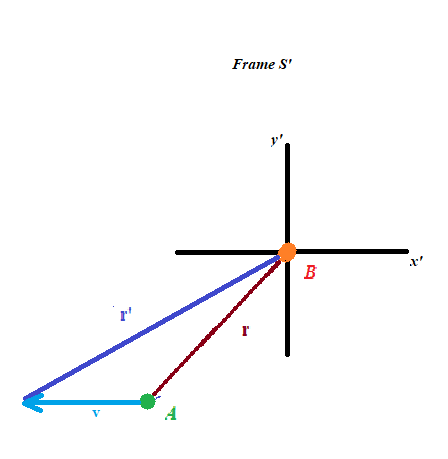
Now let's switch the positions. Now B will be the observer and you will see something interesting happening. Remember, the distance between them must be conserved when we switch from A's frame S to B's frame S':

So in this frame, B is not the one moving, and as such we know have A moving in a constant velocity v. One thing to note here though is that we also can describe A's motion relative to B in same way we did before, with the only difference being that for B, A is moving to its left, which in this convention implies the coordinates change negatively. So r'2 = r'1 - vt and it terms of its coordinates:

{x′2=x′1−vty′2=y′1

So what can we take out from all of this? First, we should realize something:

r2−r1=r′1−r′2=vt⇔r′2+r2=r′1+r1⇔{r′=r+vtr=r′−vt
Now that last part would show us a relation between the different frames, as it shows us that we could switch between S and S', and still be able to predict the motion of bodies. Even better, it shows us that if we know the movement of a body in one frame, we can easily switch to another frame and still be able to predict the results. Now a couple things you should know. This is only valid because we assume time to be the same in both frames (is what we call in physics an invariant, something that remains the same when we change frames of reference), and is in fact, referred in classical literature as Galilean Invariance, which states:
A - Time is invariant to any frame transformation in inertial frames
B - Newton's laws of motion are invariant to any frame transformation in inertial frames. (This part was added later, since Newton was born in the year Galileo died (Talk about eerie coincidences, in the same year a genius died, another was born).

In Special Relativity, we will see that is not actually true, but Galilean Relativity is still widely used in many applications of physics, like various engineerings (Since for all purposes, Galilean Relativity is really accurate for cases when we are not moving at velocities close to c).

By the way, the relations we see above allows us to switch between various referentials, in a certain way transforming the frames (or better saying, transforming the coordinates), which is why we usually refer to them as Galilean transformations. If we were considering 3-dimensional space, but with v still only in the x direction, we would have something like this:

⎧⎩⎨⎪⎪⎪⎪x′=x+vty′=yz′=zt′=t⇔⎧⎩⎨⎪⎪⎪⎪x=x′−vty=y′z=z′t=t′

And if you already know about matrices, since we are talking about vectors after all, there is a neat way to write this in a general way, like:

⎛⎝⎜⎜⎜x′y′z′t′⎞⎠⎟⎟⎟=⎡⎣⎢⎢⎢⎢100001000010vxvyvz1⎤⎦⎥⎥⎥⎥∗⎛⎝⎜⎜⎜xyzt⎞⎠⎟⎟⎟

This is general because we are considering that velocity is not only in one direction, but if you set v_y and v_z to zero you get the expression above.

And if you don't know about matrices don't worry about it, but I recommend you watch a series of videos in the youtube channel 3blue1brown, he has a playlist where he gives a good intuition on linear algebra and you can learn more about matrices and vectors and how you can use them for things like describing transformations between frames  (or vector spaces in linear algebra, which is a bit more general). After you have a better intuition of vectors, you will see why in physics, sometimes it is better to write things like this, instead of using the usual way. And it will specially useful in Special Relativity.

Some references:

Physics for Scientists and Engineers, by Serway & Jewett, 9th Edition , Part I: Mechanics, Chapters 3 (if you want to know a bit about vectors in physics) and 4 (if you want to know about motion in 2D, and they also tackle this part about relative motion). They have some exercises you can solve as well to give you a better intuition of Galilean Relativity. I also advise you to look for exercises online, both on vectors and in relative motion, and I will put some links below for you to check out.

(this is not an usual way to quote scientifically, but for a layperson, this is easier to understand, so I will quote it this way)


In this site, you find exercises with solutions to various physical problems, and I recommend you check this sections in specific if you need to look at these sections:
- https://physics.info/frames/
- https://physics.info/vector-addition/
- https://physics.info/vector-components/
- https://physics.info/vector-multiplication/
- http://www.problemsphysics.com/vectors.html
- http://www.physicstutorials.org/home/exams/vectors-exams-and-solutions/150-vectors-exam1-and-solutions

Now I believe this will be enough for you to practice a bit. One thing I've learned from all the teachers and professors I've had, is that the best way for you to get a concept, is for you to try it yourself, so I will try to motivate you to constantly do exercises if possible.

{x′2=x′1−vty′2=y

{